A Fantasy Hero Campaign Idea, Part 1 - How Magic Works
A Fantasy Hero Campaign
Magical Traditions
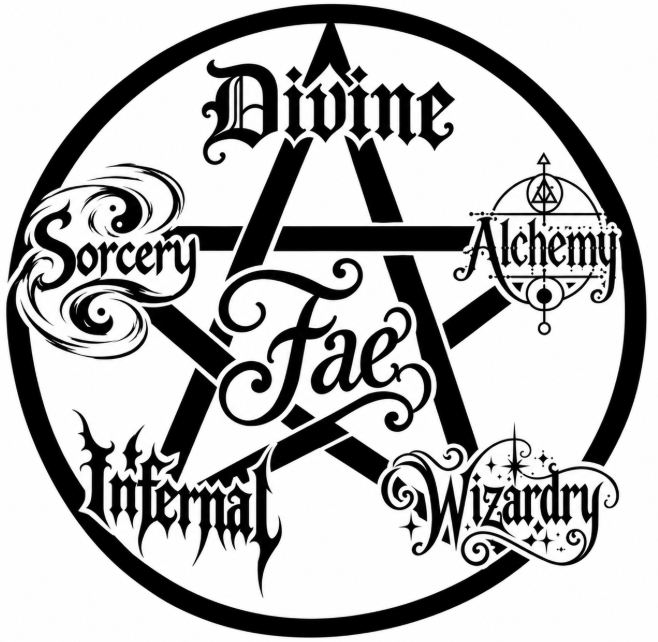
The star also gives us a surprisingly coherent philosophy:
| Tradition | Adjacent / Split Complements | Split Opposites |
|---|---|---|
| Divine | Sorcery, Alchemy | Infernal, Wizardry |
| Alchemy | Divine, Wizardry | Infernal, Sorcery |
| Wizardry | Alchemy, Infernal | Divine, Sorcery |
| Infernal | Wizardry, Sorcery | Divine, Alchemy |
| Sorcery | Infernal, Divine | Wizardry, Alchemy |
| Fae | None | None |
The common chassis
Every caster has a separate Power Skill for each tradition: Fae Magic, Divine Magic, Infernal Magic, Wizardry, Sorcery, Alchemy.
The location modifier applies directly to that casting roll:
Dedicated to the caster's tradition: +2. Adjacent tradition: +1. Opposed tradition: -1. Otherwise 0.
Fae gets +2 in Fae-dedicated places and nothing at all from the other five. No +1, no -1. That beautifully reinforces its position in the center.
This dovetails directly with HERO's Requires A Skill Roll. The normal RSR rule applies a penalty based on Active Points—normally -1 per 10 AP, though Fantasy Hero explicitly discusses changing that ratio for powerful spell systems.
A perspective on the traditions with a player perspective:
| Tradition | What powers it | Mechanical identity | Player thinks… |
|---|---|---|---|
| Fae | The living world | Environment-dependent VPP | What can nature here do for me? |
| Divine | Upper planes/deity | Grace reserve + granted portfolio | What has my patron empowered me to do? |
| Infernal | Bargained power | Infernal Debt / dangerous bargains | How badly do I want this? |
| Wizardry | Stored magic | Spells powered from magical items | How much stored power do I have left? |
| Sorcery | The caster | Personal END, fast and unrestricted | How much of myself can I burn? |
| Alchemy | Magical properties of matter | Preparation, Charges, Delayed Effect | What did I prepare before we came here? |
And that's where they start feeling very different.
Fae — ask the world
The Faeis the most flexible magic, but its flexibility comes from working with what already exists.
A Fae caster doesn't create an oak tree from nothing because they wants an Entangle. If there are roots, vines, grass, moss, water, wind, animals, stone, mushrooms, etc., they persuades or awakens them.
So, a druid walking into a forest is frighteningly versatile.
Put them in a sterile stone dungeon?
Suddenly they have stone, moisture, vermin and themself to work with instead of an entire ecosystem.
Divine — receive power
Divine magic should feel like the caster doesn't own the electricity.
Divine casters have a Grace END Reserve separate from personal END. It replenishes through prayer, worship, appropriate religious rites, perhaps particularly quickly in sanctified locations.
The actual spell repertoire is restricted by the deity's portfolio.
A war god may grant protection, courage, weapons, fire and command. A healing deity could have Healing, Life Support, defenses, purification, etc.
Most importantly: running out of Grace doesn't make the priest tired. It makes the priest temporarily unable to reach Heaven.
Infernal — borrow power
This one is tempting.
Instead, we introduce one tiny campaign mechanic:
Infernal Debt.
Normal infernal casting can work within reasonable limits. But the caster can call for more: improve the roll, Push a spell, ignore some END, produce an effect he normally couldn't manage, etc.
Every time he does, he takes a Debt.
And debts belong to whoever supplied the magic.
That is exactly what bargaining for lower-plane power ought to feel like:
"Yes. I can absolutely save everybody."
The interesting question isn't whether he can. It's what he just promised.
Debt is outside Character Point accounting. There is a small transform the goes against the BODY of the character. The GM will let the player know what happens at thresholds.
Wizardry — spend stored power
Wizardry spells cannot draw END from the wizard.
They draw from END Reserves contained in magical objects. Wand. Staff. Crystal. Orb. Ring. Runestone. Whatever. The wizard knows how to shape magic,but does not generate it.
That gives wizard players logistics:
"My staff has 17 END left. The ruby has 8. The moonstone hasn't recharged. Do I burn 6 END on this now?"
A wizard can find an ancient magical battery and think:
"Oh, this thing is useless to everyone else, but I can run half my spell repertoire off it."
Sorcery — burn yourself
No divine permission.
No ingredients.
No magic battery.
No bargain.
No convenient tree.
You are the power source.
Sorcery spells use personal END. Very few mandatory restrictions, except everything costs END and they cannot take reduced END. That makes them more expensive in Character Points, which is appropriate: reliability is valuable.
Sorcerers should also be excellent at Pushing.
"I can do it. It's just going to hurt."
HERO already makes END meaningful in heroic fantasy and supports powers drawing from either personal END or an Endurance Reserve.
So Sorcery's strategic resource isn't components, favors or batteries.
It's you.
Alchemy — prepare the magic
This one almost designs itself in HERO.
Alchemy relies heavily on Extra Time + Expendable Focus + Charges + Delayed Effect.
Potions. Powders. Oils. Smoke bombs. Runes. Salts. Acids. Transmutation circles. Incense. Elixirs.
The alchemist performs most of the magic before the adventure.
HERO's Delayed Effect is expressly useful for prepared fantasy spells, and Charges naturally work for consumable effects; powers on Charges normally don't consume END when used.
That creates a really nice contrast with Wizardry:
Wizardry: the item contains fuel, but the wizard supplies the spell.
Alchemy: the item contains the spell.
More details as I get to the details of each tradition.
Quoth!